

Origami-Inspired Robots and Metamaterials
This research explores how geometry, mechanics, and physical interactions can be harnessed to create origami-inspired robotic systems and mechanical metamaterials. I study the kinematics, nonlinear mechanics, and dynamics of origami-inspired structures, with a particular focus on how folding pathways, energy landscapes, and external physical fields govern deformation and transitions between stable states. By integrating these principles with modular design and magnetic actuation, I develop origami systems capable of programmable shape change, state control, reconfiguration, and robotic functions without onboard power or control electronics. This mechanics-guided approach provides a pathway toward lightweight, energy-efficient, and multifunctional robotic matter that can adapt its physical behavior to changing tasks and environments.
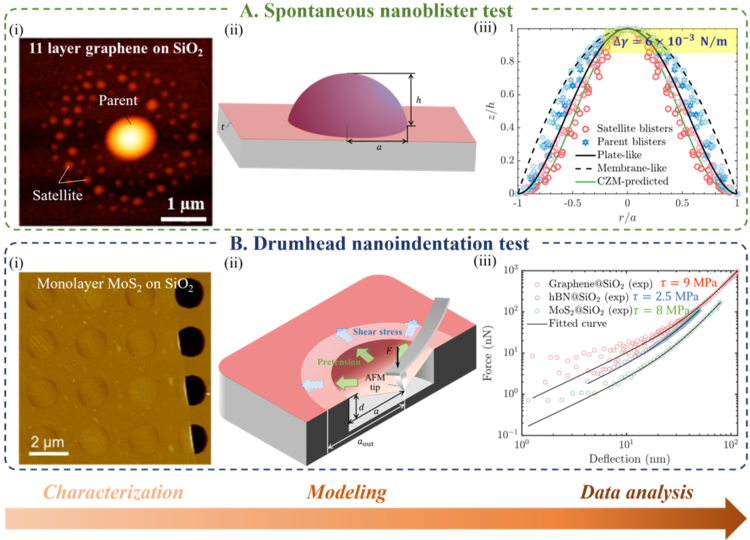
Mechanics of Two Dimensional (2D) Materials
This research investigates the fundamental mechanics of atomically thin materials, with a focus on how interfacial interactions and mechanical deformation govern their behavior and physical properties. By combining experimental nanomechanics, atomic force microscopy (AFM), and mechanical analysis, I study the coupled effects of adhesion, interfacial shear, and deformation in 2D materials. In particular, I use spontaneous nanoblister tests and drumhead nanoindentation to quantitatively characterize interfacial adhesion and shear strength, providing insights into the mechanisms of load transfer and mechanical interactions at the nanoscale. Building on a broader understanding of elasticity, adhesion, and friction in thin-film and 2D material systems, this research connects fundamental mechanics with precision nanomechanical metrology and strain engineering, offering opportunities to understand and tailor the strain-dependent physics of atomically thin materials.